Showing posts with label Colors and Patterns in German Shepherd Dogs. Show all posts

Thursday, December 21, 2017

Solid Black German Shepherd Dogs

"Lacquer Blacks": Black German Shepherds


An original Solid Black German Shepherd Dog is quite acceptable as a pure gene, although this pattern/color is not as common as sable or saddle GSD. Seemingly black color German Shepherds are really very striking, perfectly solid black GSD are seldom seen. Most back German Shepherds have little bit of tan around their toes and beneath the tail. In some cases the rectal regions & pasterns in black GSD also have tans. In some cases the solid black German Shepherds also exhibit gray undercoat over the areas like shoulders and neck. Experienced breeders like Maur Ray kennels (1940's), an American show line GSD kennel specializing in blacks documented that black GSD bred of blacks only for many generations would show fewer and fewer light hairs, until they were absolutely pure black, born without any tan. There are different schools of thoughts in regards to pigmentation in German Shepherd Dog breed, alike any other breed. Some of the contemporary well versed GSD breeders do not recommend breeding blacks to blacks in order to improve the richness of black pigments, unless the pedigree of the dogs consist of history of dark dogs of other patterns. Quite a lot of instances are there to prove that pale Black and Tan German Shepherds can also throw solid black puppies, and these puppies, on maturity, may produce pale Black and Tan puppies.


In the solid black German Shepherds the specific gene controls the formation of black pigment in the GSD - not the hair color. In the German Shepherd Dogs, alike any other canine breed, the dominance orders of coat colors is as follows: Black pigment including leather color of the nose, the rims of the eyes and pads; Carrier for liver color; Liver color - brown black colors, brown or faded black nose, non-black rims of the eyes and pads. 


The recessive gene that governs the coat color in GSD, alike other dog breeds - be it black or non-black coat color can be carried for several generations before the right coloration is achieved. Just because a recessive color does not exhibit on the pedigree your dog does not mean that any of the dogs listed siblings weren't a recessive color. This means if black has not been exhibited in your dog's pedigree for several generation, it does not mean that any of your dos siblings had not come up to be black.


Solid Black or All Black German Shepherd Dogs (Lacquer Blacks) are the gorgeous specimens and can make real companion. There is no difference in temperament, behaviors and working ability between a solid black German Shepherd and that of any other coat color. Owing to its unparalleled beauty, many people have seriously devoted in breeding All Black German Shepherd Dogs staying focused chiefly on the coloration. May backyard all black GSD breeder have ended up with mediocre quality dogs, while really serious breeders have earned a great deal of repute as Black GSD breeders.

Read more...

Buzz this

Bi Color German Shepherds

Bi Color GSD shows Good Amount of Tan Markings. 


Bi color German shepherd dog are not found as often as black and tan ones. Bi color GSDs are typically the black dogs with tan point very similar to Rottweilers and Doberman Pinschers. The tan markings in a bi color German Shepherd Dog are actually very less, and sometimes for melanistic bi color Shepherds the mask is strong black, accompanied with wider extension of the black with a black undercoat and with only very little amount of tan markings on the feet. It is due to this heavily wider extension of very strong black that the melanistic bi color German Shepherds appear to be almost solid black at times. That's the reason many people confuse a melanistic bi-color shepherd with a solid black. The whole body of the dos is black, except a few parts. A few parts of the dogs body are brown/tan -- usually on the legs, feet, under the tail, in the eyebrows, and in some cases the dogs can have small tan markings on the cheeks.


However, bi color GSD usually exhibit good amount of tan around the vent and feet, but quite a lot evidences are there to prove that strongly melanistic bi color German Shepherd Dogs have only very little tan – just enough tan marks to say that it is actually a bi color GSD, and not a solid black dog. A paler version of bi color German Shepherd Dog, on the other hand, looks much like a black sable, exhibiting wider extension of black over a ground of light grey undercoat. The pale bi color German Shepherds usually exhibit tan or gray along the lines of harness, as well as over the nape of the neck, and black markings on the legs and feet. These pale bi color German Shepherd Dogs have the gene that governs the fading of the black mantle, and still can appear quite dark. 


In the bi color Shepherds the color intensity can vary a great extent exhibiting wide range of tan and black shades and can be categorized into three broad categories viz. rich bi color GSD, Melanistic Bi color Shepherds, and faded bi color German Shepherd Dogs. The tan points of lighter markings are often seen in the bi color German Shepherds that are categorized as faded bi color German Shepherd Dogs, which is however, genetically exist in almost all patterns in GSD. In case of brindle pattern in GSD, the bi color shepherds could have showed dark stripes –just like brindle boxers - over the tan ground. 


Note: The images of Bi-Color German Shepherds have been reproduced from the original work of Linda J Shaw (www.shawlein.com)

Read more...

Buzz this

Black and Tan German Shepherds

The black tan German Shepherd Dogs can be rich black and tan, melanistic black and tan or faded black and tan GSD.


The black and tan German Shepherds also show a rich tan marking, but have black saddles or blankets which are black varying in intensity. The black mantle in a standard black tan German Shepherd should cover the nape its neck, the shoulder and the dog’s back and sides down close to the belly region, and croup and tail. It is noticed quite often that the tan or the grey markings showing at the region of neck and down the tail. At the same time if this is noticed over the croup or along the sides of the dog or if the tail does not end up with a black tip, it is an indication of pale color in German Shepherd Dogs.


As we are talking about black and tan German Shepherds, we should talk about a pattern that appears like "Salt and pepper mix look” in the region of back and withers. This is very common in German Shepherd females, and is sometimes found even in the darker females too. This pattern in found, although not too frequently, in the faded male German Shepherd Dogs. There are very faded black tan German Shepherd Dogs that are easily confused with light sable GSDs. At times the black and tan German Shepherds tend to be so fade in pigmentation that judges usually consider them faulty. Most people who are not very much acquainted with the German Shepherd Dog breed mistakenly believe that there is only one color and that is typical 'black and tan'.


Very dark black and tan German Shepherds are often confused with bi color, and may come up with nearly solid black heads, necks and bodies. Melanistic black and tan German Shepherds look quite similar to bi color ones. They usually show little bit of tan markings around the base of the ears, and have very few or no black hairs down the region of pasterns, and on the toes and hock portions.


The black and tan German Shepherd puppies are born all black.


Rich black and tan German Shepherd, Melanistic black tan German Shepherd and faded black and tan Shepherd


 Note: The images of Black-Tan German Shepherds have been reproduced from the original work of Linda J Shaw (www.shawlein.com)

Read more...

Buzz this

Sable German Shepherd Dog

Sable German Shepherds have the original wolf colors


German Shepherd has an original wolf color, with pale ground color , covered by the mantle of hard black tipped guard coat. In a sable German Shepherd this ground color is usually tan, having a heavy overlay that seems to be black when viewed from distance. Dr. Malcom B Willis Dr. Willis - the senior lecturer in Animal Breeding and Genetics, Faculty of Agriculture and Biological Sciences, The University, Newcastle upon Tyne had discussed upon the existence of two alleles for sable that are grey and yellow. It is to be remembered that similar variation in German Shepherd colors can also be found in Black Tan dogs.


A Sable German Shepherd can be identified quite easily. Sable German Shepherds (also known as agouti or wolf gray, in various colors of comparatively paler shades) usually have multi-colored individual hairs throughout the body. The Agouti gene actually determines if coat color of the German Shepherd is banded agouti coat color or a solid non-agouti coat color.


Study on mice have shown that the Agouti gene gives the mice a pale coats accompanied with having a tendency towards obesity, which may or may not hold good for dogs. Sable German Shepherds may also be masked by dark or black guard hairs. Concerning the color genes, the order of dominance of German Shepherds colors in the Agouti Series is as follow... golden sable, grey sable, saddle marked black-tan, bicolor black-tan, and solid black. In a sable German Shepherd Dog the sable color is dominant over all the other German Shepherd colors and patterns. The variation of shades in sable German Shepherds can be categorized into Rich saddle sable, black sable, faded sable. Sable may not improve the pigmentation in breeding just because the subjects are sable German Shepherds.  In a Sable German Shepherd Dog, possibilities are there that the sable can be as poorly pigmented as other patterns. If a sable German Shepherd is comparatively more more melanistic (darker) than an average Black and Tan GSD, it will appear equally dark, which in turn bring forth relatively better pigmentation to a breeding than a less melanistic subject, because the dog is genetically more melanistic (darker).


Sable German Shepherds are known for the multi-colored individual hairs, though they may have good dark mask or black guard coat as well. The color different blends of colors in the individual hairs consequently leads to a range of shades of colors and patters that may largely vary from sable German Shepherd to sable German Shepherd. The Sable German Shepherd Dogs appear in many shades ranging from of silver, gray, gold or mahogany colors. Most often sable German Shepherds have the dark mask, although at times masks tend to to be fade or sometimes almost absent. Agouti or Sable German Shepherds usually undergo few many stages of coat colors development - towards both lighter side as well as darker side, until they become fully matured i.e. around the age of three.


Sable German Shepherds are born all tan. The typical black tipping starts showing up as they reach a few weeks of age, followed by a continual process of change - either lightening or darkening until the puppy reaches an age of around three years. Sable German Shepherd puppies hence undergo an dramatic change of coat colors during their growth process. Most of the times the Sable German Shepherd puppy ends up with either darker or lighter shade.


Sable German Shepherd Dogs have wolfish look due to their original wolf colors


Note: The images of Sable German Shepherds have been reproduced from the original work of Linda J Shaw (www.shawlein.com)


Read more...

Buzz this

Sunday, August 9, 2009

Brindle German Shepherd Dog - The Lost Pattern

The Lost Pattern in German Shepherd Dog Breed - Brindle GSD

Colors and patterns in German Shepherd Dogs
have always allured the breed’s lovers. Sadly some colors and patterns are no longer existing in the German Shepherd Dog breed, as far as my knowledge goes. Blue is one of the rarest colors in the breed, while merle and brindle German Shepherd Dogs are almost out of existence. This post is about the brindle German Shepherds and is dedicated to those readers of my blog who really spare thoughts about colors and patterns in German Shepherd Dog breed. Irresponsible breeding program and negligence have thrown many patterns and colors into extinction; and brindle is just one of those extinct patterns in German Shepherd Dogs. I think it’s just because of the illogical decisions of some Kennel Clubs that many breeders and owners do not prefer keeping and breeding certain colors and patterns. I want to show my heart felt gratitude to those organizations that are working to prevent certain pigmentations and patterns from going extinct. Remember, there are NO problems related to health, genes, behavior and more specifically the working ability of the breed just because of its color. If a dog has a sound health and temperament and sound working ability, he is a good dogs, and Max Von Stephanitz – the breed founder said, “No good dog is a bad color.” So what ever color gene we have today, we need to deploy them to correct breeding program in order to prevent them from extinction like brindles and merles. These are all simply variations in color genes and do not affect the character of the dog.

brindle gsd, colors and patterns inn german shepherd dogsBrindle German Shepherd Dogs or Brindle Black Tan had been one of the founding patterns of the breed, and we have lost it, quite unfortunately. This particular gene actually affected the tan marked ground. This, in turn, made bi-colors and black tans show marble marks or dark stripes over the tan grounds, just like the brindle boxers. Candidly speaking, I have never seen a brindle dog, but I can guess who beautiful a brindle German Shepherd Dog would look like owing to the contemporary anatomical structure! We could develop the anatomy of the breed – beyond doubt! We have developed the structural aspects such as angulations and top line, but sadly lost certain genes like Brindle. Hopefully, if the brindle pattern re-appears, today’s German Shepherd breeders and owners will embrace it with love, and with a mission to protect it from further extinction. The brindle German Shepherd Dog was last surveyed in the year 1922, and unfortunately no GSD with brindle gene has been recorded in the books of any kennel club.

Eye pigmentation has always remained un-related to that of coat. Brindle coats appeared in both dark and faded versions. Many dark brindle black tan German shepherd Dogs were in the possession of faded eye color, while some dogs that had brindle markings on faded tan grounds had rich eye pigmentation.

This picture of the brindle Alsatian dog has been taken from the book on German Shepherd Dogs, authored by Brian H. Wootton. I would earnestly request my readers to help me out by providing more information about the brindle German Shepherd Dog. Also please provide me with pictures of brindle Alsatian dog, if someone has any. I promise to give you a credit for the picture in my blog.

Thanks a bunch in advance.

 ************************************************************
Many many thanks to Mary Mcintire from Michigan for sharing with us an excellent photo of her brindle GSD, named Rue.


Check out White German Shepherd Dogs FAQs

Read more...

Buzz this

Sunday, July 26, 2009

German Shepherd Dog Coat Color: Dilute German Shepherd Dogs

I am really lucky to have some good dog lover pals around me. Yes, most of my peeps are dog lovers and some of them are specifically German Shepherd lovers. Rizia Robertson is one such friend of mine who seems to have given her heart to German Shepherds. During my last conversation with her, I told her I can talk about dogs for centuries without even getting tired. She said, “well you have a friend here who loves talking about dog – especially GSD”. Are you wondering why I’m talking about Rizia? Well guys, I just want to let you know that she has been the first one to inspire me to write about gene dilution in German Shepherd Dogs. My last post on Gene Dilution in German Shepherd Dogs was written being inspired by Rizia. Truth be told here… I had written the article on GSD gene dilution for blue and liver pigments some times back in 2007, but never published it until I felt the urge post it after having days of discussion with Rizia. I would like to thank her because of this. Rizia, let your love for German Shepherd Dog never stop!

This is again another piece of information about German Shepherd Dog gene dilution. Regarding German Shepherd Dog coat color the SV breed standard said, “the color of the GSD is in itself not important and has no effect on the character of the dog or on its fitness for work and should be a secondary consideration for that reason. The final color of a young dog can only be ascertained when the outer coat has developed.” It is hence, beyond all controversy, that amongst all undesirable factors in the GSD breed, the coat color is the one that should be included as the last point in the list. My personal view is that if the coat color doesn’t affect the working ability of the breed (which the breed is actually meant for), it should be excluded from the list right way so that the two mutations of black gene in the GSD: blue and liver are not considered to be faults in the show rings. GSDs have two pigment genes: melanin/ eumelanin (brown/black) and phaeomelanin (yellow/red). Melanin is normally black, which has two distinctive mutations in GSDs – blue and liver.

As per the standard the blues and the livers are genetic faults, and no reputable German Shepherd Dog breeder will breed these so-called faulty genes. The GSD breeders, who breed these genes, with both parents as carriers, end up with a shallow genetic pool. In most cases the liver and blue puppies usually come by accident. Frankly speaking, I haven’t yet come across a breeder who breeds to produce liver and blue pups deliberately. But here, again the same thing, I would like to say. If the color genes don’t affect the working ability, character and behavior of the breed, what’s harm in livers and blues? This is a very debatable question and I won’t go in for arguments and debates, nor would I like to criticize any bloodlines. I would rather say that diluted dogs may descends from high quality specimens from top bloodlines that have proved even in the Schutzhnd trial fields.

blue german shepherd dogs liver german shepherd dogs dilute german shepherd dogs
Just a gist about Blue and Liver genes in German Shepherd Dogs

Blue Gene in German Shepherd Dogs

  • Double recessive color gene
  • Rare color
  • Dilute gene, which means it dilutes the black pigment in the dog.
  • Considered a disqualifying fault by the AKC.
Liver Gene in German Shepherd Dogs
  • Double recessive color gene
  • Rare color
  • Dilute gene that blocks the black pigment in the dog.
  • Considered a disqualifying fault by the AKC
You can also check out:

GERMAN SHEPHERD DOG COLORS AND PATTERNS
and
GERMAN SHEPHERD DOG STANDARD

Read more...

Buzz this

Sunday, July 19, 2009

Gene Dilution in German Shepherd Dog – Blue and Liver Dilution

Blue German Shepherd Dogs and Liver German Shepherd Dogs

The blue and liver GSDs had been the rarest genes once upon a time that have always captured breeders’ attention. Fortunately these genes are not as rare as it used to be some years back. The search volumes for the blue and liver GSDs in the Internet have been on a rising, which is gives an indication that people are looking for these genes more these days, either for puppies or to get information about the blue and liver German Shepherd Dogs. There are actually two possible dilutions for the black color in German Shepherd Dogs - “Blue Dilution” and “Liver Dilution”. Here’s just some information about these rare German Shepherd genes – the recessive blue and liver gene.

Colors of these German Shepherds are different from the regular ones that we usually see in the dog shows. They are real striking in appearance, if bred correctly. If not bred well, these dilutions usually come with blues and brown nose, while the standard requires the nose, nails, eye rims and lips to be black strictly.

Patterns of Blue Dilution in GSD

Blue German Shepherd DogsThe blue gene in German Shepherd Dogs actually turns the pigmentation of both skin and coat into bluish or steel grey, which is usually very dark. The tan area, on the other level, remains almost the same tan markings as we see in regular shepherds. Sometimes the tan ground may take a faint silvery tint. In the German Shepherd Dog breed, there are great chances of the blue gene to occur in any pattern and type of coat. This finally dilutes the black pigment.


Patterns of Liver Dilution in GSD

Liver German Shepherd DogThe liver gene affects the dog’s pigmentation in almost the same way. The liver gene in German Shepherd Dogs dilutes the black pigment, thereby turning both the coat and skin into liver brown color. Like the blue genes this also dilutes the eye pigmentation by giving the eyes a wrong tint – silvery-yellowish-brown color. The liver gene can come in any pattern alike the blue one. The tan markings seem almost the same as in the regular GSD.

In either of the two dilutions the dog looses it black pigmentation, which is replaced by either blue or liver pigments. Remember the gene that gives color and the gene that gives pattern are two distinctive genes. This ensures a good chance that either dilution can come with three different patterns, viz. solid color, two-toned pattern and agouti. Both these dilutes in German Shepherd Dogs are seen with two-toned pattern and agouti, more commonly than with solid colors. Solid blue and solid liver German Shepherd Dogs are rare of the rarest genes in the world. In most cases the liver and blue German Shepherd Dogs comes with liver-brown and blue noses respectively. Both these gene dilutions in German Shepherd Dogs affect the eye pigmentation too!

Read more...

Buzz this

Thursday, June 25, 2009

White German Shepherd Dogs - Should Not be a Separate Dog Breed

White German Shepherd Dog Information

I have been receiving so many emails from my readers, looking for White German Shepherd dog information. Although I own the regular black-and-tan German Shepherds, and not the white one, yet I can share my little bit of knowledge on white German Shepherd Dogs that I have gathered by studying about them all these years.

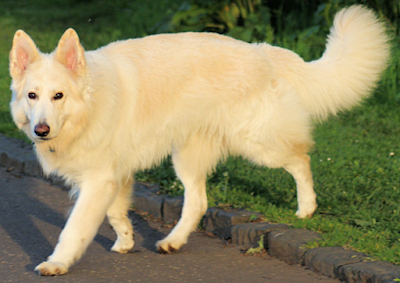
Greif - the grandsire of the first registered Shepherd – Horand von Grafrath was a white dog. Hence the gene for the white coats has always been a part of the German Shepherd Dog breed since it’s very inception around 1898. Strong efforts had been made by Germany and other countries of the world to eliminate the white German Shepherds, but an increasing popularity have been noticed with passage of days. Around hundreds of whites German Shepherd Dogs are being registered in Canada, and thousands in the United States each year.

White German Shepherd Dog, White German Shepherd Dogs, White coated German Shepherd Dog, White GSDThe white color was made disqualification in GSD Breed Standard by the German Shepherd Dog Club of America sometimes around 1960s. Up until that time, the White German Shepherd Dogs were allowed to compete in conformation show rings. Since white GSD has been disqualified from the AKC and CKC show rings, most GSD breeders do not breed white dogs. Fortunately the White Shepherd clubs in North America has been pursuing the target of breed separation for the white GSD for years now, in the hopes of getting the proper recognitions that the beautiful White German Shepherds actually deserve.

Extensive studies have been carried out with the White GSD breed and has been finally determined that there exists a significant gene pool that make it a separate breed… naming it as White German Shepherd Dog!

  • 1999 – The UKC officially recognized White German Shepherd Dog as a separate breed from April 14, effective from May 1, 1999.
  • 2002 – The FCI officially recognized White German Shepherd Dog as a separate breed, naming it as "Berger Blanc Suisse".

White German Shepherd Dog, White German Shepherd Dogs, White coated German Shepherd Dog, White GSD
My view about White German Shepherd Dogs

My view is that, this is just a misconception that white coated German Shepherd Dog will be best treated by separating it as a distinctive breed altogether. Why should the beautiful White GSDs be outcast, just because of their natural white recessive gene? Just the white color of the coat (by natural recessive gene) cannot be the basis for breed separation. Good news is that the White German Shepherd Dog Club of America (WGSDCA) does not support breed separation.
Just like any other pure bred GSD, the white coated German Shepherd Dogs are quite a lot versatile and can be found working with police forces, in drug interdiction units, bomb detection squads, tracking, community activities, attack work, rescue departments, herding flocks, guiding the blind, assisting the handicapped, working as therapy dogs, guarding the home and what not???

Stay tuned… up next the White German Shepherd Dog FAQs!

Read more...

Buzz this

Wednesday, September 10, 2008

A Bit About Colors and Patterns in German Shepherd Dogs

german shepherd information, black german shepherd puppies, german shepherd info, german shepherd size, breeding german shepherds, sable german shepherds, white german shepherd dog, black german shepherds, german shepherd silver, sable german shepherd, white german shepherd dogs, white german shepherdWell, don't be scared... this is one of the toughest chapter. I have been consulting a varried sources since years. Today I just felt like I should write on the colors and patterns in GSDs. Many a times I've been hit by querries, as to whether there is only these colors in GSDs that we usually find in localities and dog shows. Nah.... a lot more are there that are not seen in general dog shows, nor in our localities. Some of the pigments have been declared to be conformation fault; some are really rare genes. But, hey... I'm not a scientist, nor do I understand the magic of gene to the fullest extent. Nor again have I come across all these colors. But I can show you some pics of really awesome pigments and patterns that I've collected while exploring the web randomly. I started gathering info about the colours and patterns in GSDs and related pictures in the year 2003 or so, when my CIZAR (pronounced as 'Scissor') was just a li'l boy.

When we think of GSDs, the image that reflects in our mind is a robust dog with errect ears, bushy tail, brown almond eyes and royal gesture and kingly gait, with saddle-black or black-tan markings. However, German Shepherd Dogs come in a wide range of colors... saddle-black or black-tan are the ones that are most commonly found. GSDs can be one solid colour – either solid white or solid black. Besides, there are colors like sable with black mask. The patterns include a varried combinations like black & tan, black & red, black & cream, solid black, solid white (conformation disqualification, although a pure gene - not albino), sable (various colorations). GSDs als come in black & silver, liver (rare - conformation fault) and even blue (rare - conformation fault).german shepherd information, black german shepherd puppies, german shepherd info, german shepherd size, breeding german shepherds, sable german shepherds, white german shepherd dog, black german shepherds, german shepherd silver, sable german shepherd, white german shepherd dogs, white german shepherd This topic of colors and patterns in German Shepherd Dogs should should not be taken for granted. It is one of the most serious point to be kept in the forefront of mind, especially if you are an aspiring breeder or have already started breeding German Shepherd Dogs. Dr Malcolm B Willis wrote two books "The German Shepherd Dog: A Genetic History" and "Practical Genetics for Dog Breeders", which are still a couple of unparallel books about German Shepherd Dog breed and the genetic configuration thereby. Based on the information in these books here is a brief summary of the patterns and color inheritance in GSDs. Colors in German Shepherd Dogs, as in many other breed as well, are actually controlled by some series of genes.

AGOUTI SERIESgerman shepherd information, black german shepherd puppies, german shepherd info, german shepherd size, breeding german shepherds, sable german shepherds, white german shepherd dog, black german shepherds, german shepherd silver, sable german shepherd, white german shepherd dogs, white german shepherd

  • Golden sable
  • Grey sable
  • Saddle marked black and tan
  • Bicolor - black and tan (bicolor is where the dog has tan only on the legs and face, not on the body)
  • Black

BLACK SERIES (gene controls the black pigment formation)

  • Black pigment includes nose, eye rims and pads
  • Liver color
  • Liver color - brown black colors, brown nose, eye rims and pads.

WHITE SERIES (The gene that controls 'White' is recessive to all other colors. In order get a white coat color, both parents must carry the white gene - either be white themselves or be carriers of white gene)

  • Melanin is produced (Standard GSD's colors have this)
  • Partial albinism - chinchilla (not seen)
  • White coat with dark eyes and nose (not albino)
  • Yellowish coat collar (proposed)

COLOR SERIES (This gene controls the intensity of non-black pigments)

  • Cream - Lightest tan
  • Tan - Intermediate tan
  • Red - Darkest tan

DILUTION SERIES (The gene controls how intense the black pigment will be)

  • Dense pigment
  • Blue dilution
  • Black pigment-blue dilution together begets a blue coat which looks as though it has a dusty or flour sheen.

MASK SERIES

  • A prominent black mask on the face
  • Entirely dark coat without the mask on the face
  • Brindle (Brindle striping on the legs - The rarest of the rare gene – Almost extinct)
  • Clear tan
german shepherd information, black german shepherd puppies, german shepherd info, german shepherd size, breeding german shepherds, sable german shepherds, white german shepherd dog, black german shepherds, german shepherd silver, sable german shepherd, white german shepherd dogs, white german shepherdNow here's just a note of mine. I have friends and acquaintances who believe that Black (Solid Black) is a separate gene altogether. They mean to say that Solid Black is altogether a distinctive marking pattern that is controlled by an entirely a separate gene. Researchers view it in a bit different way. They say that Solid Black is only the darkest version of the Agouti Series - Agouti marking pattern. Another very common thing that I have noticed is the small white marking in the chest region. I used to think that that was by any chance associated to white gene. german shepherd information, black german shepherd puppies, german shepherd info, german shepherd size, breeding german shepherds, sable german shepherds, white german shepherd dog, black german shepherds, german shepherd silver, sable german shepherd, white german shepherd dogs, white german shepherdJust the last time, I came up with a beautiful litter of REVA and REX. That wagsd info, about German Shepherd Dog Information,  german shepherd dog kennel west bengal, German Shepherd Facts, GSD information, German shepherd dogs breeders, gsd breeders, gsd breeders india, gsd breeders west bengal, kennels west bengal,  gsd facts, gsd interesting facts, dog kennels west bengal, dog kennels hooghly, gsd facts, gsd interesting factss a small litter of three, one of which, I remember, had a small white patch on the chest. I sat back with the pedigree chart again and spent a lot of time over the web and with some of my books and study materials. There wasn't a trace of white gene in the parental lineage of both the Dam and Sire. I was amazed with the magic game of gene! It may be a recessive trait that expresses itself in the absence of a dominant one or may be something really still obscure to the mankind! Stay tuned... I will be talking more about colors and patterns of GSDs and the Brindle one - the one that we do not find these days.


Relevant Reads


Read more...

Buzz this

Last Year's Most Read Out Posts

Advertise with us

About This Blog

All you need to know about German Shepherd Dogs. Read out what I have to share with you regarding the amazing German Shepherd Dog breed. Are Alsatian dogs and German Shepherd Dogs same? Who was Max Von Stephanitz and What is SV? Also learn a bit more in depth on German Shepherd Dog training tips, German Shepherd puppy care tips, German Shepherd Dog behavior, German Shepherd instinct, German Shepherd Dog standard and history of German Shepherds.

  © Our Blogger Template for Aringsburg's German Shepherd Dogs

Back to TOP